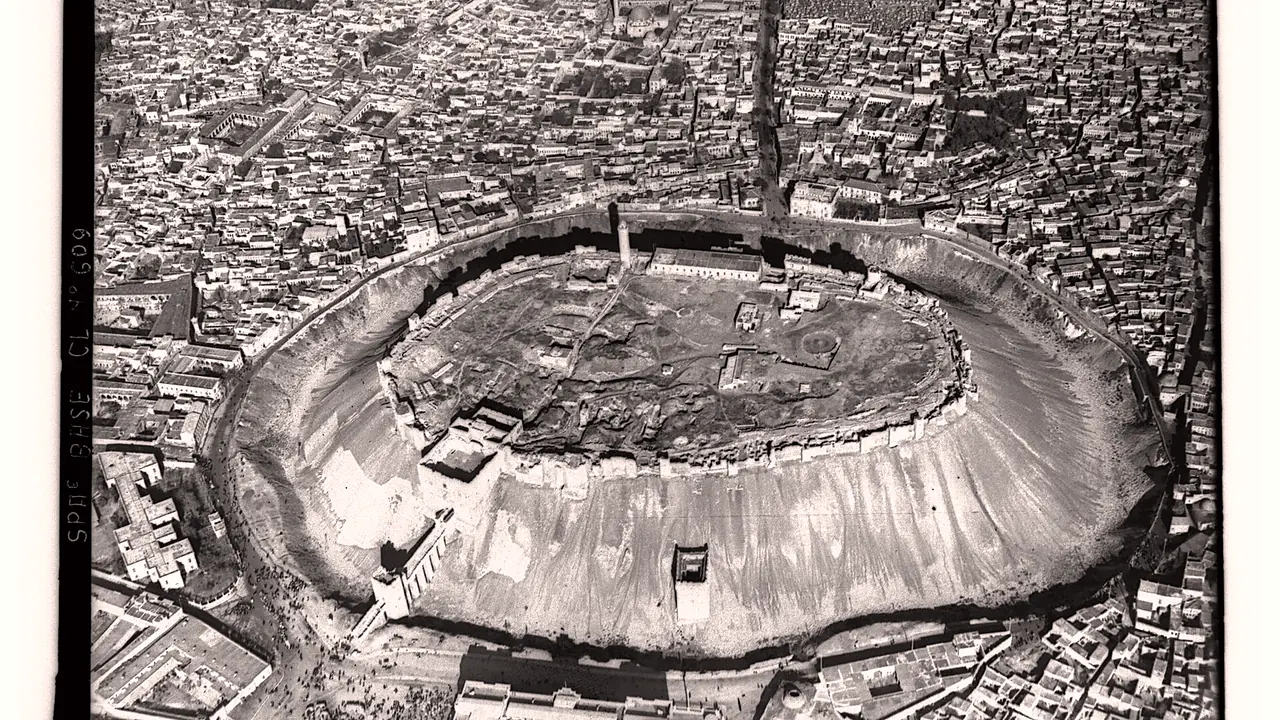
Ebla
The first sanctuary of the storm god — rough stones and plaster laid on bare bedrock. Kings of Ebla rode thirty-five miles to sacrifice here.
Yamhad
The temple rebuilt as a tower, its hall ninety feet by fifty-five with a northern wall thirty-three feet thick. Cuneiform texts describe a colossal seated Addu holding the sun god on his knee.
The Hittites
The temple reoriented to Teshup and filled with basalt: lions, a sphinx seven feet tall, bull-men, and a fish-man holding a pinecone and a purification bucket.
Neo-Hittites, Palistin
King Taita restored the temple and left an inscription in Luwian hieroglyphs. Friezes of Ishtar, scorpion-men, and the storm god in his chariot.
Neo-Assyrians
The temple already abandoned. The relief style developed at Aleppo travelled east and reappeared in the palaces of Nimrud.
Babylonians and Persians
Administration without monument — the mound governed, but nothing on it is attributed to them.
The Seleucids
The acropolis of Beroia: two metres of settlement, the Hellenistic well, and the trench that uncovered the Hittite reliefs and left them untouched.
The Romans
Acropolis and sanctuary; remains suspected under the modern theatre. The emperor Julian came up here in 363 and sacrificed a white bull.
The Byzantines
Two churches, both later mosques, and the Byzantine Hall. When the city walls failed, Aleppo came up the hill.
Umayyad to Mirdasid
Sayf al-Dawla abandoned his riverside palace for the mound after the Byzantine sack of 962. Churches converted to mosques.
Nur al-Din Zangi
A ramp, a palace, a racecourse, restored mosques, a carved wooden mihrab now lost. Crusader kings held in the dungeons — Joscelin II, Raynald of Châtillon, Baldwin II of Jerusalem.
al-Zahir Ghazi
The Citadel you are standing in: the moat, the glacis, the bridge, the entrance block, the Palace of Glory, the hammam, the Great Mosque, the water shafts.
The Mamluks
The Throne Hall on top of the gate, both advance towers, and the rebuilding of 1415 after Timur.
The Ottomans
Barracks and a windmill. Around two thousand people lived on the mound in 1556; some fourteen hundred in 1679, of whom three hundred and fifty were Janissaries.
Mandate and Syria
Wall repairs, the Damascene ceiling, the 1980 theatre, the museum, the excavation shelters, the Aga Khan conservation programme — and the damage of 2012–2016 and its repair.