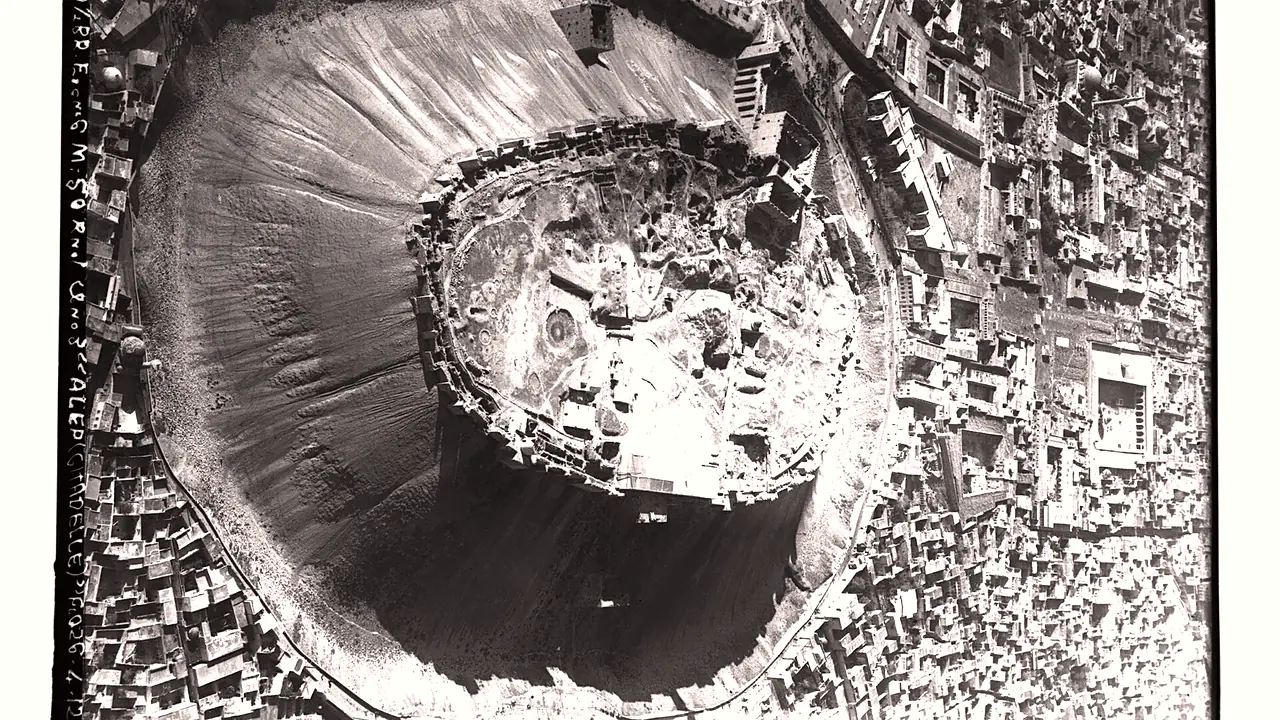
Ebla
The first sanctuary of the storm god — rough stones and plaster laid on bare bedrock. Kings of Ebla rode thirty-five miles to sacrifice here.
Evidence: Excavated
Yamhad
The temple rebuilt as a tower, its hall ninety feet by fifty-five with a northern wall thirty-three feet thick. Cuneiform texts describe a colossal seated Addu holding the sun god on his knee.
Evidence: Excavated and textual
The Hittites
The temple reoriented to Teshup and filled with basalt: lions, a sphinx seven feet tall, bull-men, and a fish-man holding a pinecone and a purification bucket.
Evidence: Excavated
Neo-Hittites, Palistin
King Taita restored the temple and left an inscription in Luwian hieroglyphs. Friezes of Ishtar, scorpion-men, and the storm god in his chariot.
Evidence: Excavated
Neo-Assyrians
The temple already abandoned. The relief style developed at Aleppo travelled east and reappeared in the palaces of Nimrud.
Evidence: Documented
Babylonians and Persians
Administration without monument — the mound governed, but nothing on it is attributed to them.
Evidence: Documented only
The Seleucids
The acropolis of Beroia: two metres of settlement, the Hellenistic well, and the trench that uncovered the Hittite reliefs and left them untouched.
Evidence: Excavated
The Romans
Acropolis and sanctuary; remains suspected under the modern theatre. The emperor Julian came up here in 363 and sacrificed a white bull.
Evidence: Documented and inferred
The Byzantines
Two churches, both later mosques, and the Byzantine Hall. When the city walls failed, Aleppo came up the hill.
Evidence: Standing
Umayyad to Mirdasid
Sayf al-Dawla abandoned his riverside palace for the mound after the Byzantine sack of 962. Churches converted to mosques.
Evidence: Standing and documented
Nur al-Din Zangi
A ramp, a palace, a racecourse, restored mosques, a carved wooden mihrab now lost. Crusader kings held in the dungeons — Joscelin II, Raynald of Châtillon, Baldwin II of Jerusalem.
Evidence: Standing and documented
al-Zahir Ghazi
The Citadel you are standing in: the moat, the glacis, the bridge, the entrance block, the Palace of Glory, the hammam, the Great Mosque, the water shafts.
Evidence: Standing
The Mamluks
The Throne Hall on top of the gate, both advance towers, and the rebuilding of 1415 after Timur.
Evidence: Standing
The Ottomans
Barracks and a windmill. Around two thousand people lived on the mound in 1556; some fourteen hundred in 1679, of whom three hundred and fifty were Janissaries.
Evidence: Standing
Mandate and Syria
Wall repairs, the Damascene ceiling, the 1980 theatre, the museum, the excavation shelters, the Aga Khan conservation programme — and the damage of 2012–2016 and its repair.
Evidence: Standing